This all shows the emotions going on with our narrator. He’s not cold or unfeeling. He’s just acting that way to save face.
Introduction
This album has been full of vocal heavy songs, and I am here for it. I do love a soft SKZ song. (I have a whole playlist of them, actually.) And in addition to being just a beautiful song in general, “Way Out” has layers and layers of emotion throughout the lyrics and the performance.
So, let’s jump right in.
Couple disclaimers: I don’t speak Korean. I am using my limited SKZ knowledge and the English translations from Genius. These are my own thoughts based on those translations and not meant to be a definitive interpretation.
Here is the song to listen to as you read:
Background
We have even less background on this song than we did for “I Do.” They talk a lot in the album intro video about pulling from 2nd Gen KPOP sounds and that they like doing more sentimental songs. And they list a few of their songs that they see in this category: “Mixtape: On Track,” “Sorry, I Love You,” “Ex,” and “Leave.”
And they compare “Way Out” to “After You” in theme and feel. But Chan makes the distinction that these two songs are on different ends of the relationship spectrum. “After You” is the beginning, the crush, the falling in love. And “Way Out” is the end – a cold end, specifically.
Lyrics
This gets into the lyrics, of course, because once again, they have written layers and layers of emotions into these lyrics.
On first listen, this is a very cold, harsh goodbye. Just in the very first chorus, the very beginning of the song, we get this:
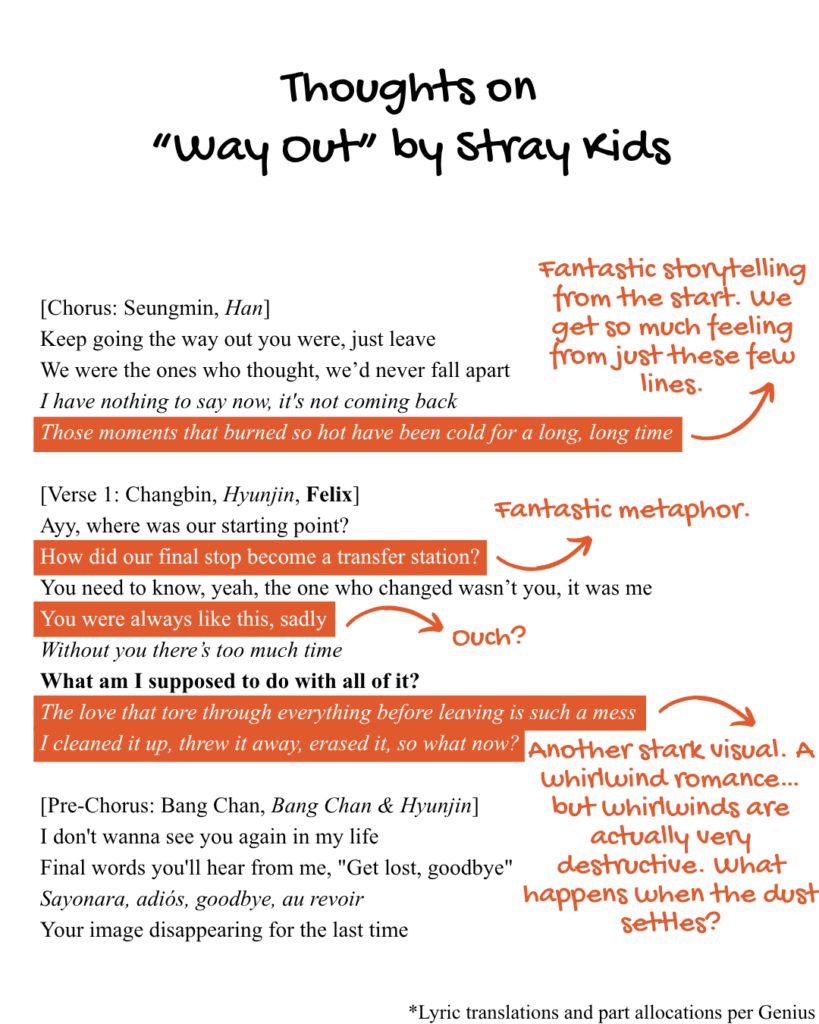
[Chorus: Seungmin, Han] Keep going the way out you were, just leave We were the ones who thought, we’d never fall apart I have nothing to say now, it’s not coming back Those moments that burned so hot have been cold for a long, long time
Instant dismissal from the very first line. It’s blunt. Unfeeling. Uncaring.
And this continues throughout the song:
You need to know, yeah, the one who changed wasn’t you, it was me You were always like this, sadly
I don’t wanna see you again in my life Final words you’ll hear from me, “Get lost, goodbye”
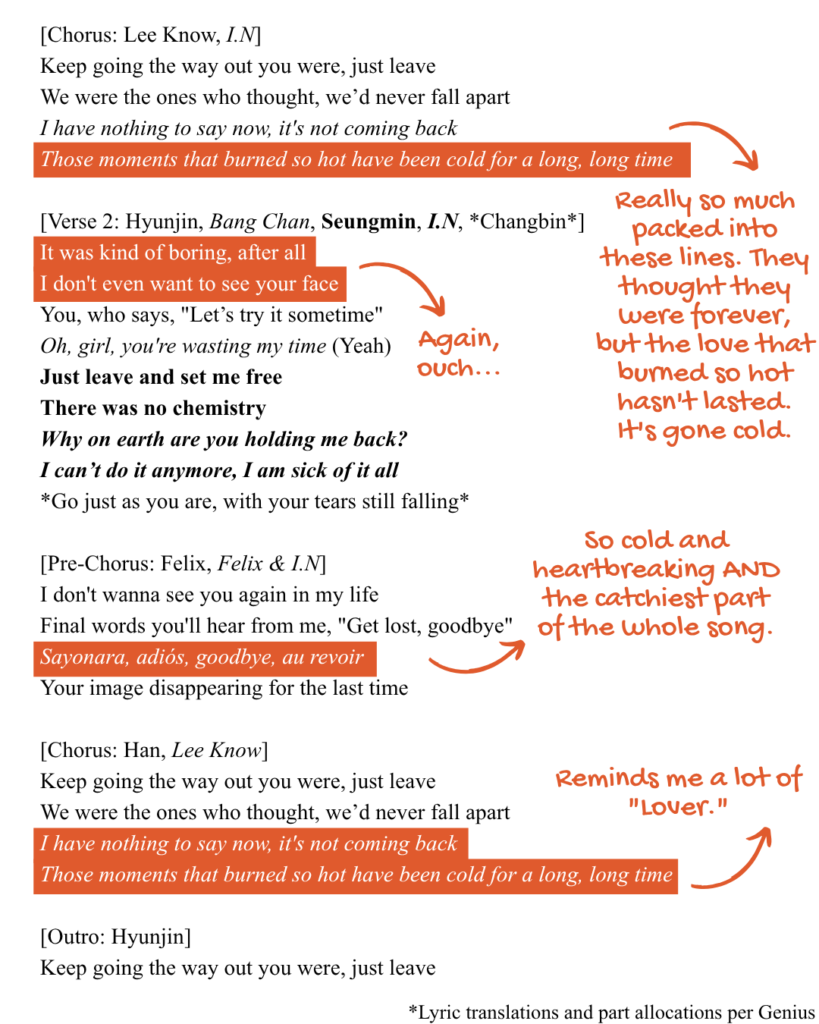
It was kind of boring, after all I don’t even want to see your face
Oh, girl, you’re wasting my time.
Go just as you are, with your tears still falling
Dismissive. Cold. Blaming it on her. “You’re the one who changed. You’re wasting my time.”
I watched K-Pop with Seolly’s video on this song, and one of the things she points out in that very first line is the word 꺼져줄래 (kkeojyyeojullae). It’s translated as “just leave” or “get lost,” but the connotation in Korean is harsher. It’s not used for small annoyances. It’s used in moments of anger and hurt.
And there’s obviously a lot of hurt behind these harsh words, a sense that the narrator is masking sadness with cruelty.
Those moments that burned so hot have been cold for a long, long time
Ayy, where was our starting point? How did our final stop become a transfer station?
Without you there’s too much time What am I supposed to do with all of it?
The love that tore through everything before leaving is such a mess I cleaned it up, threw it away, erased it, so what now?
We start to see the emotion behind the cold mask. Wondering where it all went wrong. Sadness at the good times ending. Overwhelm at all of this time he now has because she’s no longer in his life to fill it up.
Seolly points out a couple of nuances in Korean that backs this up.
In the pre-choruses, we get “goodbye” in several languages, one being Korean. But they use the word 잘 가 (jal ga), which literally means “go well.” It’s a softer goodbye.
The same goes for the last line in verse two. The word 가줘 (ga jwo) is translated as “go.” The first syllable is 가 (ga), which is “go” on its own. But adding 줘 (jwo) makes it softer, pleading – “Please go.”
And this line in verse two holds a bit of a double meaning:
도대체 왜 날 붙잡아?
Why on earth are you holding me back?
In the English translation, it’s given a subject – you. She is holding him back. Another cold shoulder line. But in Korean, there is no subject. It’s not clear who (or what) is holding him back. Is it her? Is it their relationship? Or is it the good memories keeping him from moving on or even breaking off the relationship in the first place?
These are only a couple examples, and I highly recommend watching Seolly’s video. She goes line by line to break down the nuances, and it’s absolutely fascinating.
On top of that, we have metaphors. And you know how much I like a metaphor. Three specifically add to this melancholy feel we have going. All of them speak to a love that burned hot and fast, a love that they thought would last forever but didn’t.
Those moments that burned so hot have been cold for a long, long time
The first is fire. A burning passion. A love that starts with a spark and fans quickly into a flame that is warm and perfect. Until it goes out. And then you’re left to slowly grow cold and watch that warmth slip away.
Ayy, where was our starting point? How did our final stop become a transfer station?
The second is trains. They believed that this relationship was the end, the last stop on the line, the destination. But it’s turned into a transfer station, a place to go their separate ways.
The love that tore through everything before leaving is such a mess
And the third might be my favorite. Because when I first read this line in English, all I could think of was the phrase “whirlwind romance.” It has the same feel as the fire metaphor – a romance that’s fast, that sweeps you off your feet, that’s exciting and overwhelming. But whirlwinds are destructive. Like the fire slowly dying, what happens when the dust settles?
I see a lot of similarities here with “Still Here” and “Lover.” “Still Here” is about grief, about going back to memories over and over and not being able to move on. “Lover” is heartbreak, raw and painful, the result of a breakup he never thought he’d have to experience.
This all shows the emotions going on with our narrator. He’s not cold or unfeeling. He’s just acting that way to save face.
I experience this often, even if it’s to a lesser degree. I feel hurt or angry, and instead of lashing out, I shut down. I brush it off or I’m passive aggressive. It’s a defense mechanism and a way to try to make the other person either leave you alone, feel bad, or both.
Music & Performance
And, of course, the music and the performance backs this up, too. The track, like “After You” and “I Do,” is very simple. There a few shifts that highlight certain lines, like in verse two where the guitar riff we’ve had the whole song cuts out completely.
It’s really there to let the vocal performances shine. And they SHINE. The line that really catches my attention every time is Changbin’s at the very end of verse two. There’s so much emotion in just that one line. You can feel it as you listen.
And there are these tonal shifts between the choruses and the verses, some more flat, some rounder and fuller. Again, showing this duality of forced coldness, trying to sound uninterested and unemotional but failing miserably.
Conclusion
I really love doing these deep dives, and it’s not necessarily because it changes the way that I listen to the songs. It does! I actually know what they’re singing about, at least on a whole song/theme level. But I don’t think about what every line means in English as I’m attempting to sing along in the car.
It’s really because it allows me to understand them more – as writers, as artists, as performers. We get a lot behind the scenes content of producing and recording and filming, for sure. And we’ve gotten more about their writing process recently, especially with the 3RACHA podcast. But the actual act of writing a song doesn’t make for very interesting visual content. Vlogging a writing session could be very boring. I would love to see it! I would be so fascinated! But it might not do very well numbers wise for the amount of work it would take to produce.
And so I’m left with little snippets here and there of their creative process from album intros and lives and promo videos where they drop a one or two sentence comment about how a song came to be. And I have the lyrics themselves. And I’m always amazed at how much I can find in those lyrics.
It’s just one more way to appreciate them and their brilliance. And this song is just another in a long line. And I’m only just getting started! I have many, many…many more songs to go!
You can find posts about the other songs on this album here:

Leave a Reply